Connector, Fuse and Diode Parts in One Look
One page on the manufacturer's site gathers the parts that sit at the ends of a string: MC4 and solar connectors, solar fuse connectors, solar diode connectors and PV cable assemblies. For a solar cable connector the published evidence is a CE / RoHS certificate download on the connector page, while KUKA CABLE does not publish current or voltage ratings for individual connector models on the pages read, so those figures have to come back from the supplier as a datasheet.
Key takeaways
- The site lists three connector families plus assemblies: MC4 / solar connectors, solar fuse connectors and solar diode connectors, with PV cable assemblies alongside.
- A CE / RoHS certificate download is published on the connector page; per-model current and voltage ratings are not.
- The cable behind any connector is published as tinned copper, class 5 to IEC 60228, with a rated voltage of DC 1.8/1.8 kV and an ambient ceiling of +90 °C.
- A wire harness processing base was established in June 2021, which is where pre-terminated assemblies belong.
The three families, and what each one does
A string of modules produces three distinct connection problems, and the site's part list maps onto them. The first is the ordinary mating pair at the end of a module lead, where two cable ends have to join and later be pulled apart by hand; that is the MC4 and solar connector family. The second is protection inside the string, where a fuse holder interrupts the run and a solar fuse connector makes that interruption a pluggable item. The third is the bypass path, where a solar diode connector puts a diode in line so that a shaded or failed module does not take a whole string out of service.
Alongside those three the site lists PV cable assemblies. An assembly answers a fourth question: who terminates the cable. Buying a pre-terminated run moves the crimp, the insertion check and the sealing of the joint into a workshop, which is useful when the same harness is repeated hundreds of times across an array.
All of them are described as part of the PV system range that KUKA SOLAR has handled since its PV division became independent in August 2018: DC cables, AC cables, inverter plug wires, connectors and wiring harnesses, with TUV, SAA, CPR and other certifications named on the site.
Where each part sits in the circuit
Reading the list against a single-line diagram shows which parts a project needs. Module leads mate at the junction between two modules, so a large array consumes mating pairs in the hundreds and expects them to be opened by a technician wearing gloves. String ends run to a combiner box, and that is where a fuse holder earns its place, because the string can be isolated without dismantling the wiring. Diode connectors belong at the module or sub-string level, where the bypass function protects against partial shading.
The fourth item, the assembly, crosses all three. An inverter plug wire is a factory-made lead with the connector already fitted; a harness is a set of those leads cut to length and labelled for a specific layout. Because the wiring harness processing base was established in June 2021, that work sits inside the same operation as the cable itself.
What the connector page publishes
The connector page publishes a CE / RoHS certificate that can be downloaded, and the site list names the families above. It does not publish a current rating, a voltage rating, a contact resistance figure, an ingress-protection rating or a mating table for individual models, and it does not publish prices or minimum order quantities for them either.
That gap matters because a connector is often bought by catalogue number alone. Four questions close it: what continuous current the mated pair carries, what voltage it is rated for, how it is sealed once mated, and which cable cross-sections its gland accepts. The published cable diameters give a first check on the last one: 5.5 mm at 4 mm², 6.0 mm at 6 mm² and 7.5 mm at 10 mm² for the range's commonly used sizes, so a connector body stated for the whole 4–10 mm² group has to accept a spread of 2 mm.
The joint inherits the cable's temperature
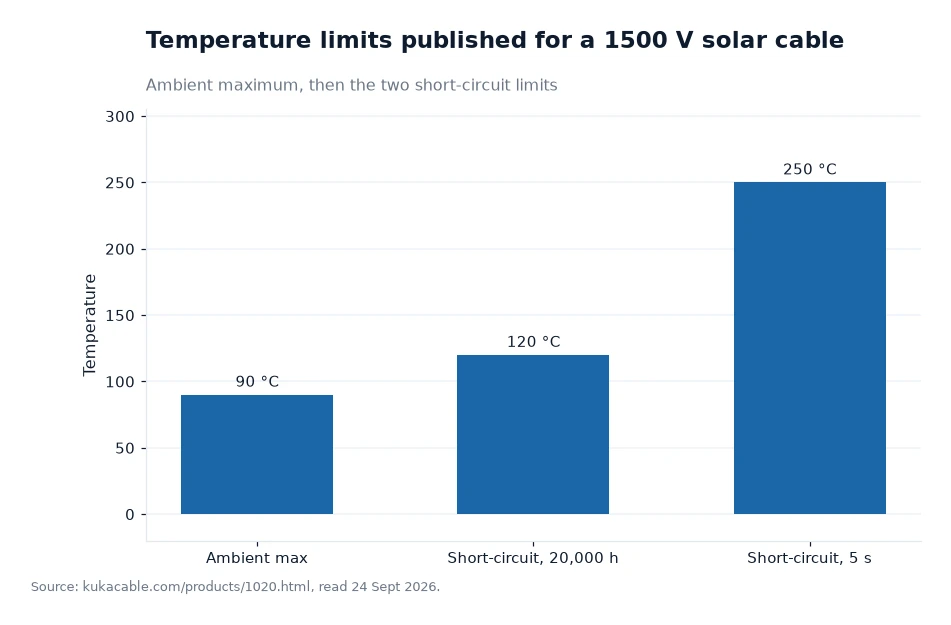
Read the bars as the conditions a mated pair shares with its cable. A connector sits on the end of the same conductor, so it sees the same ambient, and it adds its own contact resistance to the circuit. The 90 °C bar is the ambient ceiling the cable is published for; the 120 °C bar is a sustained short-circuit allowance lasting 20,000 hours; the 250 °C bar is five seconds. In my own conversion, 20,000 hours is 833 days, or about 2.3 years of continuous operation, and it assumes the allowance is cumulative, which the page does not state.
The important asymmetry is that these are cable figures. The site publishes no equivalent temperature or current-withstand figure for a connector body, so a specifier cannot assume that a part which mates correctly also shares the cable's fault withstand. That has to be asked for, and the answer belongs in the project file next to the cable test record.
Fuse and diode parts in the same review
A fuse connector is a mechanical item with an electrical rating supplied by whatever fuse is fitted into it, and the site does not publish a rating for the holder. A diode connector is similar: the diode's forward current and reverse voltage decide the protection it gives, and those are not published on the pages read. What the site does publish is the family list and the certificate download, enough to order a known part number but not to select one from first principles.
The cable-side numbers are the ones a buyer can check directly. Every assembly uses the same conductor and jacket described elsewhere on the site: tinned copper of class 5 flexibility to IEC 60228, XLPO insulation and sheath, both electron-beam cross-linked and LSHF, a rated voltage of DC 1.8/1.8 kV, and proof tests of a 10 kV spark test in production and 6.5 kV AC for five minutes on the finished cable. The standards named for the range are TUV 2PfG 1169/08.2007, EN 50618:2014 and IEC 62930.
| Part family | Published detail | What to request before ordering |
|---|---|---|
| MC4 / solar connectors | Listed as part of the PV range; CE / RoHS certificate download on the connector page | Mated current and voltage ratings, sealing method, accepted cable diameter |
| Solar fuse connectors | Listed as a separate family on the same page | Fuse size accepted and the rating of the holder in the string |
| Solar diode connectors | Listed as a separate family on the same page | Diode forward current and reverse voltage, and the assembly method |
| PV cable assemblies | Wire harness processing base established June 2021 | Lengths, labels, connector orientation and test record for the assembly |
| Underlying cable | Tinned copper class 5 to IEC 60228; XLPO jacket, LSHF; rated DC 1.8/1.8 kV | Datasheet confirming cross-section, diameter and nominal weight |
| Proof testing | Spark test 10 kV in production; 6.5 kV AC test voltage for five minutes | Batch record for the cable used in the assemblies |
Worked example
Price the connector decision by mass, using only published figures. A five-metre plug wire made from 6 mm² cable carries 78 g/m, so the cable in one lead weighs 390 g; the same lead in 4 mm² at 59 g/m weighs 295 g. The difference is 95 g per lead. My arithmetic, and it assumes a straight multiplication by length with nothing added for the connector bodies.
Now scale it. A combiner box fed by ten such leads carries roughly 0.95 kg more in cable if the leads are specified at 6 mm² rather than 4 mm², before the connectors are counted. That extra mass hangs on the terminations, and every gram of it is carried by the crimp and the gland. Both multiplications are mine, from the published nominal weights. The conclusion for a buyer is not to choose the smaller size automatically, but to check that the connector body and its strain relief were selected for the mass of the cable actually specified.
Frequently asked questions
Are connector ratings published for each model?
No. The site lists MC4 / solar connectors, solar fuse connectors and solar diode connectors and publishes a CE / RoHS certificate download for the connector page, but the pages read carry no current rating, voltage rating or ingress-protection figure for individual models, so those have to be requested as a datasheet.
Can the connectors be supplied already fitted to the cable?
Yes. PV cable assemblies and wiring harnesses are listed as part of the range, and the company page records a wire harness processing base established in June 2021, so pre-terminated leads can be ordered from the same operation that makes the cable.
What to ask for in one message
Send the layout and the part families in a single request. Name the connector type needed at each position, the cable cross-section and colour, the lead lengths and any labelling, and the standards your inspector will check — the range is described against TUV 2PfG 1169/08.2007, EN 50618:2014 and IEC 62930. Then ask for the datasheet for each connector model, the CE / RoHS certificate copy, the assembly test record, and a written statement of the mated current and voltage ratings.
Four documents close the review: datasheet, certificate, assembly test record and the ratings statement. The manufacturer publishes the cable side of that file across its own pages — the range in the solar cable section, the construction and proof tests on the 1500 V product page and the certificate names on the certificates page — and the connector side has to come from the same supplier in writing.
Connector names and the temperature bars shown above are the manufacturer's own, on kukacable.com, its website, read there 24 Sept 2026[1].