Inside Lipstick Manufacturing: From Formula to Filled Bullet
A lipstick leaves the factory as a filled bullet, but it is decided long before that: the base and its wax-to-oil ratio, the pigment dispersion, the moulding temperature and the cooling time each sit upstream of the tray you see in a photograph. A 5,000-unit first run needs about 19 kilograms of finished mass before filling loss, and knowing that number is what turns a quotation into a schedule.

Key takeaways
- Two steps come before any production: formulation determination, then sample preparation.
- A library of 10,000+ mature formulas shortens the first step; a bespoke system makes it the longest part of the project.
- Filling loss is real, so a 5,000-bullet order is quoted above 19 kg of finished mass.
- Pigment dispersion decides shade consistency, which is why it is settled before the fill, not after.
Step one: formulation determination
The first decision is whether the bullet is built on an existing base or a new one. A mature formula library — one supplier publishes more than 10,000 formulations — lets a project start from a base that already behaves, then adjust glide, payoff and wear. A new base starts from the wax and oil ratio, which is the single biggest lever on how the bullet feels and how it holds shape in a warm car.
Adjusting an existing base is not a compromise on brand identity. It is the same formula architecture with a different finish: the texture, the fragrance and the skin feel are the fields that get tuned.
Step two: sample preparation
Sampling is where a lipstick brief becomes physical. The lab hand-pours small batches so the shade and the texture can be judged before the bulk is committed, and the sample round is also where the moulding temperature is checked against the pack. A bullet that looks right on a card can still fail in a slim case if the base is too soft to hold.
Order the sample in the pack you plan to ship. The gap between a moulded bullet and the inner sleeve is a manufacturing tolerance, and a sample poured into a generic shell will not reveal it.
From bulk to filled bullet
Once the shade and the base are signed off, the mass is prepared in bulk, milled for pigment dispersion, then moulded and cooled on trays. Cooling is where a lipstick shows its formula: too fast and the surface dips, too slow and the production line stalls. Suppliers who run colour lines already have that window in their process sheet.
The last stage is the physical one. Filled bullets are inspected for surface defects, weight and straightness before they are sleeved, and that check is what protects the retainer around the bullet rather than the bullet itself.
Order quantity, batch size and line time
The order minimum sets everything downstream. For colour work the published minimums commonly land between 1,000 and 5,000 units, and a first order can start at 500. The batch you have to make follows from the bullet weight and the quantity, so the two numbers belong in the same email.
| Item | Published figure | What it sets |
|---|---|---|
| Order minimum | 1,000–5,000 units per product | The mass you have to prepare in bulk |
| Start-up minimum | 500 units | Smallest shade and texture trial |
| Formula library | 10,000+ mature formulas | Whether step one takes days or weeks |
| New development | 3–6 months | One block covering research, testing and production |
Batch records and what they buy you later
A colour product lives or dies on repeats. The first run proves the shade can be made; the second run proves it can be made again. That is why the batch record matters more for lipstick than for almost any other category: base lot, pigment lot, temperatures, fill weights and the inspection result all belong in it.
Ask what a repeat order will be judged against. A supplier who keeps a retained sample from the approved run can compare the next batch against the physical reference rather than a photograph, and that comparison is what protects the brand from a visible shade drift between two production runs.
Keep the record on your side too. Store the approved sample, the pack artwork and the filling specification together, so a reorder placed a year later does not restart the brief from a description of "the red one".
Worked example: the mass behind a 5,000-unit run
Take a standard 3.8 g bullet. At 5,000 units the finished mass is 5,000 × 3.8 g = 19,000 g, or 19 kilograms. Add a 2% filling loss and the bulk becomes 19,000 × 1.02 = 19,380 g, just over 19.4 kilograms. The 3.8 g and the 2% are my assumptions; the order quantity and the published band are not.
Now put the same order against line time. A plant publishing 160 million units a year across 35+ lines runs 438,356 ÷ 35 = 12,524 units per line per day, so 5,000 bullets is 5,000 ÷ 12,524 = 0.4 of a line day, roughly three hours. Colour lines are slower than that average because of the cooling step, which is exactly the reason a factory schedules a pilot around other runs.
Reading the capacity and minimum chart
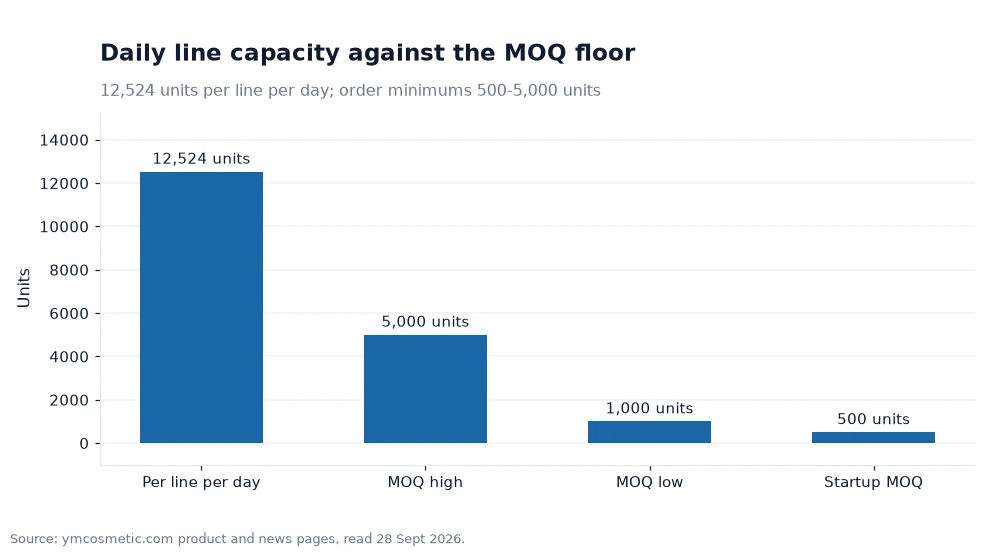
The bars are deliberately on one axis because they answer one question: how much of a day does your order take? The tallest bar is the line, the other three are order floors. A 500-unit trial sits at 500 ÷ 12,524 = 4% of a line day, which is why it is quoted as a favour and not as a schedule.
Frequently asked questions
How long does a lipstick project take from brief to delivery?
It depends on the route rather than the colour. An existing base can be adjusted and sampled in weeks, while a new development is quoted as a single block covering three to six months. Shade matching sits inside both routes.
Can a shade be matched exactly to an existing product?
It can be matched very closely, and the practical measure is a colour difference tolerance agreed in writing before the fill. Pigment dispersion is the variable, so ask how the supplier records the reference shade and how each batch is compared against it.
Do small orders get the same quality checks?
They should. Inspection of weight, surface and straightness happens on the filled bullet regardless of quantity, and the batch record is what makes a repeat order possible later. Ask to see one batch record from a comparable colour run.
Using the process as a checklist
If you can name the base source, the shade reference, the bullet weight and the order quantity, you have specified most of the project. The supply side of the same question — how to compare the private label lipstick manufacturers on your shortlist — is a matter of asking for the process sheet, the batch record and the inspection criteria rather than the catalogue. Yunmei's OEM/ODM manufacturing overview shows how a project moves from formula selection to a filled, packed product, and the skincare product pages are worth reading alongside it when one brand carries both colour and skincare.
Source of the order minimums, formula library size and capacity arithmetic: the manufacturer's site ymcosmetic.com, read on 28 Sept 2026. My assumptions are the 3.8 g bullet weight and the 2% filling loss used in the worked example, so you can swap in your own.[1].