What Buyers Should Know About Planning cost inputs before importing from China
Planning import cost inputs from China means combining the product quote with tooling, packing, transport, insurance, customs, destination handling, inventory, and quality assumptions. Buyers should show who supplied each estimate, confirm classification and charges with qualified parties, and update the model whenever product, route, or quantity changes.
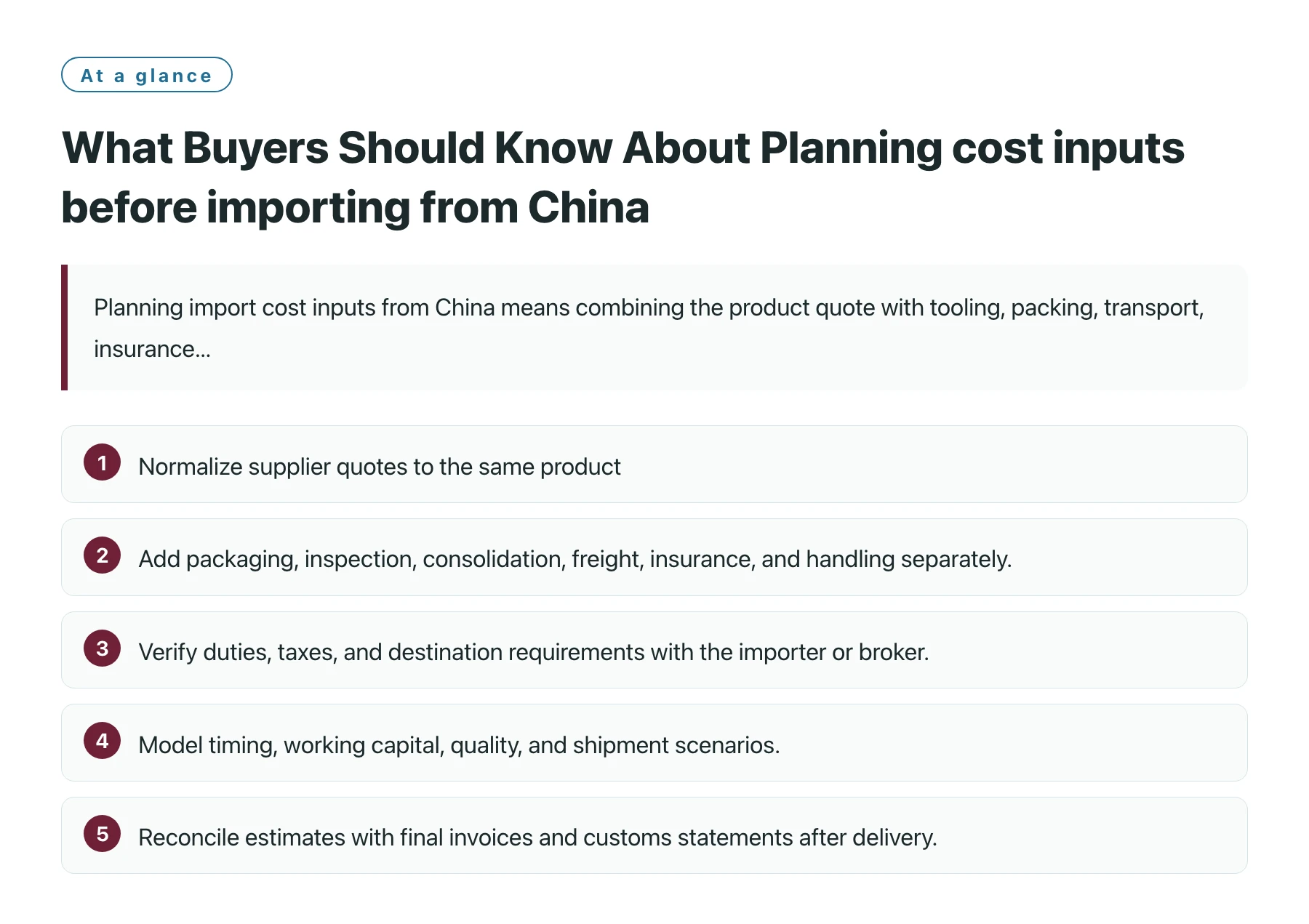
Key takeawaysNormalize supplier quotes to the same product, quantity, currency, and delivery term. · Add packaging, inspection, consolidation, freight, insurance, and handling separately. · Verify duties, taxes, and destination requirements with the importer or broker. · Model timing, working capital, quality, and shipment scenarios. · Reconcile estimates with final invoices and customs statements after delivery.
An import cost comparison becomes misleading when some quotes include delivery and others stop at the factory. A consistent model makes assumptions and unknowns visible.
Build the cost model from the product outward
Start with the supplier’s quoted product price and the exact quantity, configuration, currency, and delivery term. Add tooling, customization, packaging, labeling, samples, inspection, testing, and any local pickup or consolidation charges that are outside the quoted unit price. Keep one-time costs separate from recurring costs so the order quantity does not hide the setup burden.
Record quote validity, payment milestones, deposit basis, bank charges, and assumptions about exchange rates. If one supplier prices per piece and another per carton, convert both to the same unit and confirm carton quantity. Do not combine alternate models or different specifications in one comparison row.
Identify what the quote excludes. A low ex-factory price may leave freight, export handling, insurance, destination port fees, duties, taxes, broker charges, delivery, and storage outside the offer. Ask the supplier and forwarder for itemized estimates and label uncertain values as estimates rather than commitments.
Separate freight, insurance, and handling assumptions
Choose a delivery term with a named place and confirm which party arranges pickup, export clearance, main carriage, insurance, destination handling, and final delivery. Compare offers using the same Incoterm and route assumptions. Freight quotes may depend on dimensions, gross weight, volume, dangerous-goods status, season, service level, and booking date.
Request carton dimensions and weights after packaging is finalized. Estimate palletization, loading, consolidation, warehousing, customs brokerage, port or terminal handling, and last-mile delivery separately. For mixed suppliers, account for the cost and time of receiving, counting, labeling, and combining goods at a consolidation point.
Insurance terms should specify insured value, covered risks, deductible, claimant, and document requirements. The buyer should confirm coverage with the insurer or broker rather than assuming a freight quote includes it. Record who is responsible for filing a claim if damage occurs in transit.
Estimate duties and destination charges carefully
Import charges depend on the product, classification, origin, destination, entry type, and rules in force when the goods arrive. The importer or its qualified customs broker should verify the tariff classification, customs value, origin treatment, permits, and agency requirements for the actual product and country. A supplier’s estimate or online calculator is not a final customs determination.
For U.S. imports, CBP states that duties, taxes, and fees can vary by commodity and entry mode, and that additional federal charges may apply to certain goods. Its current guidance describes merchandise processing and harbor maintenance fees for applicable entries.[1] Use current official schedules or a broker estimate for the shipment, then update the model when the classification, value, route, or rules change.
Keep customs charges distinct from domestic sales taxes, brokerage service charges, port storage, demurrage, exams, and delivery fees. Ask who invoices each amount and when it becomes payable. Include a reserve for uncertainty where appropriate, but do not disguise the reserve as a known duty rate.
Add time, inventory, and quality costs
Landed cost is more than cash paid to the factory and carrier. Consider working capital tied up in deposits and stock, expected transit and storage time, inspection and rework, replacement shipments, shortage exposure, and the cost of a missed launch or project date. These values may be internal estimates; show the assumptions and decision owner.
Model scenarios for the variables that can move: order quantity, exchange rate, freight service, destination charges, duty treatment, inspection findings, and supplier delay. Compare a consolidated shipment with separate shipments if waiting for one late supplier would affect critical inventory. Use ranges when an exact charge is not yet available.
Separate avoidable costs from fixed costs. An expedited shipment caused by late approval may call for a different corrective action than a recurring packaging charge. After delivery, reconcile estimates with supplier invoices, forwarder bills, customs statements, and warehouse charges.
Use a comparable template and update it at release
Build one worksheet with product price, quantity, tooling, samples, packaging, inspection, pickup, consolidation, export handling, freight, insurance, customs, destination fees, broker, delivery, storage, and internal assumptions. Include currency, source, date, responsible party, confidence level, and whether the amount is fixed, estimated, or variable.
Before purchase release, confirm the chosen configuration, quantity, delivery term, route, tariff assumptions, and charge owners. Obtain current quotes for material transport costs and have the importer or broker review destination charges. Refresh the model if any order detail changes.
For Shanghai JS Sourcing, importers can request a landed-cost breakdown tied to supplier quotations, packaging assumptions, shipment route, and identified exclusions. Define which items are sourced as estimates and which require confirmation by a freight forwarder, insurer, broker, or local tax adviser.
Sources
Frequently asked questions
Does a supplier’s landed-cost estimate guarantee the final import charges?
No. Classification, origin, destination, entry mode, route, and rules can affect charges. The importer should confirm current amounts with qualified customs and logistics providers.
What should be included beyond the factory price?
Add tooling, packaging, inspection, pickup, consolidation, freight, insurance, customs, broker, destination handling, delivery, storage, and stated inventory assumptions.
How should an uncertain cost be recorded?
Label it as an estimate, record its source and date, identify the responsible party for confirmation, and show the scenario or range used in the comparison.
When should a landed-cost model be updated?
Refresh it when quantity, product configuration, packaging, delivery term, route, classification, origin, freight quote, or relevant import rules change.