Withdrawal Fees vs Mining Fees: The Two Costs of Getting Paid
Miners usually argue about one number and ignore the other. The mining fee is a listed percentage applied to defined parts of a payout — 4% on the PPS-settled block-reward component and 2% on the transaction-fee component under PPS+. Withdrawing mining earnings, by contrast, is listed as zero-fee. At 1 PH/s that difference is worth about $45.59 a month on the fee side and nothing on the payout side.
Key takeaways
- Mining fees are charged on income as it is settled; under PPS+ the listed rates are 4% on the block-reward component and 2% on the transaction-fee component — not a single blended charge.
- Mining payouts are listed as zero-fee, so moving earned coins into your own account does not add a second percentage on top of the pool fee.
- At 1 PH/s, gross output is about 0.000449 BTC a day, roughly $37.99; 30 days is $1,139.80, and 4% of the block-reward slice is about $45.59.
- Electricity, not fees, is the dominant cost at scale: a 10 PH/s farm at 20 J/TH spends about $288 a day on power at $0.06/kWh against $379.93 of gross output.
Context in 2026
Difficulty sits at 132.76 T with an estimated 2.12% decrease at the next adjustment, the network runs at roughly 1,003 EH/s, and the coin that most miners are paid in trades near $84,692. In that environment a small percentage difference in fee handling is easier to see than it was during a bull run, because the gross number it multiplies is thinner relative to power cost.
It is also easier to misread. Fee discussions online tend to flatten two distinct mechanisms into one figure: the charge the pool applies to earnings as they are settled, and the charge that appears when coins move out. They operate at different points in the pipeline, they are calculated on different bases, and only one of them is currently listed at zero for mining payouts.
The two variables that matter
The first variable is the settlement basis under your payment method. PPS+ pays the block-reward portion per accepted share, so your income is smooth and the pool carries pool-luck and orphan risk — which is why the listed fee on that portion is the higher of the two. The transaction-fee portion of a payout is distributed with PPLNS logic at a listed 2% fee. PPLNS as a whole method merges both portions and distributes them together at a listed 2% fee, leaving reward variance with the miner.[1]
The second variable is the payout rail. Once earnings are settled, they sit in an account balance and can be withdrawn, spent into another supported asset, or left to accumulate. On the mining side ViaBTC lists zero-fee mining payouts, which means the act of getting paid does not deduct a second percentage from what the pool already settled.[2] When you later move coins on-chain to an address you control, the fee you see is the network's, set by block space rather than by the pool.
| Cost event | When it is charged | Listed basis | Monthly cost at 1 PH/s |
|---|---|---|---|
| PPS+ fee, block-reward component | At hourly settlement | 4% of the PPS-settled slice | About $45.59 |
| PPS+ fee, transaction-fee component | As blocks are credited | 2% of transaction fees earned | Scales only with fee income |
| PPLNS fee, alternative method | After 6 confirmations | 2% of combined reward and fees | About $22.80 if applied to all income |
| Mining payout withdrawal | When earnings leave the account | Listed as zero-fee mining payouts | $0 |
| On-chain transfer to your own address | Whenever you broadcast | Network fee, set by block space | Variable, independent of the pool |
Read the table as a sequence rather than a menu. The first two rows happen automatically, at settlement, on income you never had to claim. The last two happen only when you decide to move. A miner who never withdraws never pays the bottom row, and a miner who withdraws daily is exposed to that row fifty-two times more often than one who withdraws monthly — which is a cash-management decision, not a fee negotiation.
Numbers from a real rig
Take a 0.5 PH/s setup — 500 TH/s. Daily output at current difficulty is 0.000224 BTC, which is $19.00 at $84,692. Over 30 days that accumulates to 0.006729 BTC and $569.90 gross before fees. Apply the listed 4% to the block-reward portion and roughly $547 of that reaches the account.
Now price the power. At 20 J/TH, 500 TH/s draws 10 kW, which is 240 kWh a day. At $0.06/kWh the electricity bill is $14.40 a day, or $432 for the month. So the monthly picture is $569.90 gross, about $22.80 of PPS+ fee, $432 of power, and a margin near $115 — before accounting for any downtime at all. One eight-hour outage in the month removes about $4.33 of expected output, which is a smaller number than most operators assume but a real one.
Scale the same arithmetic to 10 PH/s and the shape holds: 0.004486 BTC a day, $379.93 gross, power of about $288 a day at $0.06/kWh, and an hourly settlement that returns roughly 0.0001869 BTC — about $15.83 — every hour. At that cadence, electricity invoices and hosting invoices can be paid out of mining inflows rather than from a separate cash buffer, which is the practical reason settlement frequency is worth more attention than a fraction of a percentage point on a fee schedule.
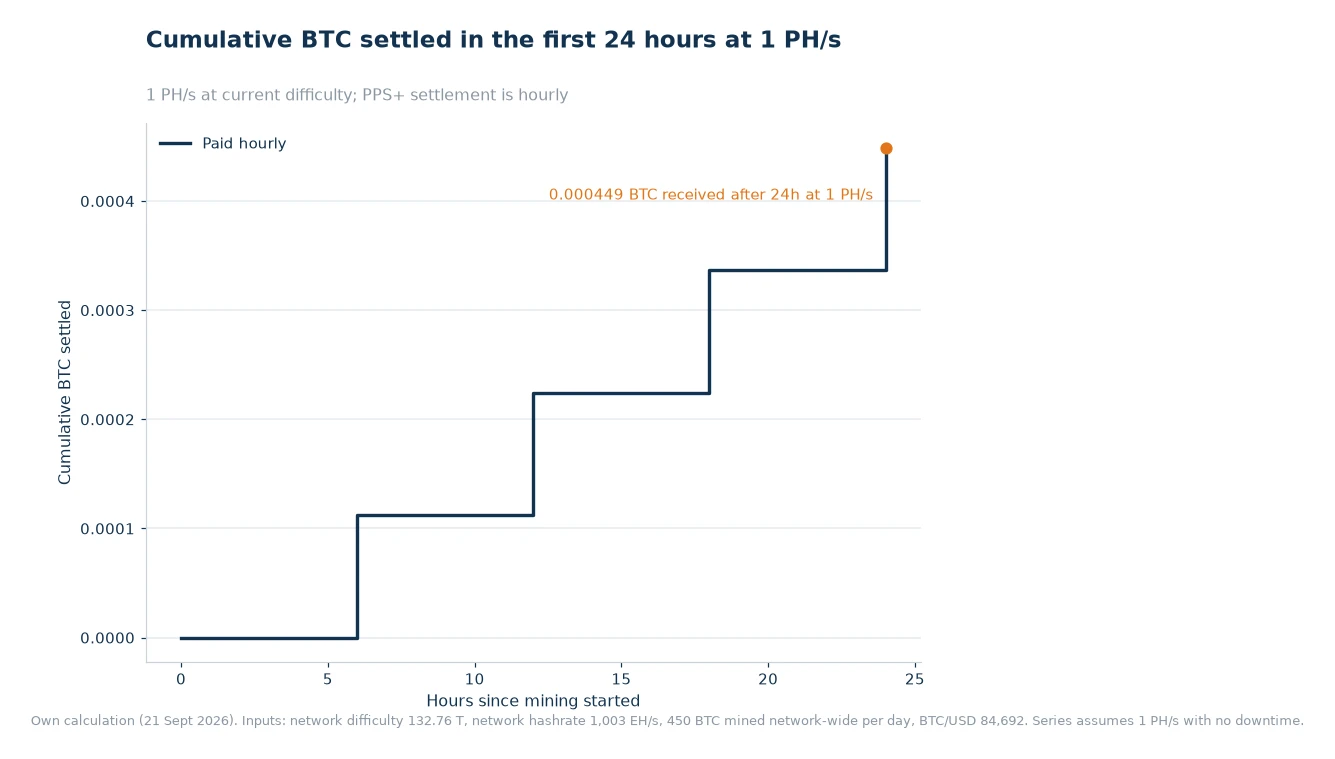
What that chart shows is the first variable doing its job. Settlement arrives in roughly equal increments, so cash-flow planning is a matter of counting hours rather than waiting on a block. Whether those increments then leave the account for free or as a coin that can be converted inside the same balance sheet is the second variable, and it is the one worth checking before moving mining revenue to an exchange: an in-account conversion replaces a withdrawal, a deposit and their associated waits.
Decision guide
- Ask what each percentage applies to. A 4% charge on the block-reward component and a 4% charge on total income are very different numbers in a month where transaction fees spike.
- Separate settlement from transfer. Treat hourly settlement as income and on-chain transfers as treasury operations; mixing the two makes marginal fee differences look larger than they are.
- Keep earnings where they are cheap to hold. A wallet built into the mining account avoids a withdrawal step every time you want to rebalance, and it keeps deposit addresses, balances and conversion in one place — which is what the ViaBTC Crypto Wallet is for.
- Reconcile against published pool data. Your realised output should track pool hashrate, network hashrate and difficulty closely; if it drifts, the cause is usually your own uptime rather than the fee. The pool statistics view is the reference point for that check.
- Budget power first. Build the spreadsheet in the order power, hardware, fees. Miners who start with fees are optimising the smallest line item.
Frequently asked questions
What happens if my miner goes offline?
Shares stop, so expected income stops with them. Alerts and a dashboard that shows per-worker hashrate shorten the gap between a failure and a fix.
Is a bigger pool always better?
Size reduces payout variance but also concentrates hashrate. What matters more is fee structure, uptime, latency and payout cadence.
Are mining payouts really free to withdraw?
Mining payouts are listed as zero-fee, so the pool does not deduct a second percentage when settled earnings are moved. A transfer you broadcast to an external address still pays the network's own transaction fee, which is set by block space, not by the pool.
Should I withdraw daily or monthly?
Withdraw when you need the coins elsewhere. Each outbound transfer carries a network fee, so touching a small balance repeatedly costs more in total than a single larger movement, while hourly settlement means the balance is available whenever you decide.
Judge the whole pipeline, not one number
Write down the fee basis at settlement, the transfer cost at withdrawal and the power cost per kWh, in that order of measurability. Then check realised hourly income against the pool's published hashrate and difficulty once a month; if the two agree, the only remaining lever is uptime. That is a shorter list than most fee debates suggest, and it is the one that shows up in a bank statement.
Data and sources: ViaBTC fee schedule and component breakdown[1] and ViaBTC wallet and payout documentation[2]. Network difficulty (132.76 T), network hashrate (1,003 EH/s), 450 BTC mined network-wide per day and the BTC/USD price of 84,692 are from public chain data and market feeds read on 21 September 2026; every dollar and BTC figure here is our own calculation from those inputs, and no return is promised or implied. Re-run the arithmetic when difficulty or price moves.